Books
- Leonhard Euler and the Bernoullis: Mathematicians from Basel
- MBW Tent
- ages 12 and up

This book is a collection of tales about men who were integral in the creation of the mathematical principles in Probability. This book is a fictional dialogue that is actually historically accurate. Its contents give students a firm basis of life in the 16th and 17th centuries and tell of how these men discovered their name-bearing theorems.
- A Very Improbable Story: A Math Adventure

- Edward Einhorn & Adam Gustavson
- ages 7 and up

This book is a picture book that details a young boy's day and the many challenging and improbable things he must complete in order to get a cat off his head. The boy must complete games of daunting probability from the time he brushes his teeth until late in the evening. The book contains hilarious depictions of the scenes and details the mathematics used in each situation.
- The Cartoon Guide to Statistics
- Larry Gonick & Woollcott Smith
- ages 14 and up
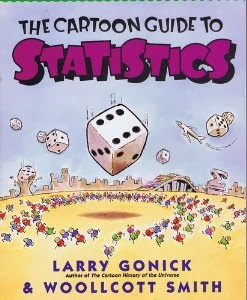
This book has an uncanny ability to provide informational and often humorous depictions of instances in which probability and statistics are prevalent in the real world. The material covered in this work are of higher level, yet are written in a manner understandable by early high school students. Theories of probability are easily portrayed in this work.
- Probability Demystified
- Allan Bluman
- Ages 14 and up

This book is another example of a work that presents the difficult material of a probability course in a manner easily understood by beginner students. The work contains the major theorems of the course as well as topics that are often taken for granted (sample space, events, etc). The book contains all of these and up to the many higher-level aspects of probability.
- Math Made Easy: Combinations and Permutations
- Dawn LaBuy-Brockett
- Ages 5 and up

This book teaches the many aspects of combinations and permutations, from the basics to the more in-depth concepts that entail. The work contains easily understood explanations and pictures detailing factorials, groups, ordered sets, and more. The pictures are clear and concise and provide a great "hands up" for the reader.
________________________________________
Websites
- Tales of Statisticians: Jacob Bernoulli
- http://www.umass.edu/wsp/statistics/tales/bernoulli.html
- Ages 18 and up
An in-depth look at the life and accomplishments of one of math's greatest minds. Bernoulli is the mind behind the Bernoulli Trials, an integral aspect of the probability curriculum. The work also notes the other, maybe less-known discoveries of Jacob Bernoulli.
- Better Explained: Easy Permutations and Combinations
This website is perfect for the beginner probability student as it details, in layman's terms, how to calculate permutations and combinations. The terminology used in this site is very simple yet very forth. It tells the reader exactly what is needed in a very direct manner. The site also has multiple images that depict the situations perfectly.
- Probability Test 1 Flashcards
- http://www.cram.com/cards/probability-test-1-379658
- Ages 13 and up
Cram.com is a site in which the general public can post files for subjects across the board. This particular file is a set of flashcards that detail multiple key vocabulary terms for an introductory probability course. The site allows students to cycle through the "front" of the flashcards to quiz themselves and allows the students to flip from front to back when studying.
- Experimental Probability - Horse Basketball Game
- http://math.about.com/od/probability/a/Prob_JL.htm
- Ages 11 and up
This site is actually an in-depth example of experimental probability. The girls in this situation are vying to win at "Horse". The students are then given the outcomes of ten games and are asked to derive the probability of many other situations. This would be perfect to provide a real world application of the concept.
- Probability Through Problems: A New Approach to Teaching Probability
- http://nrich.maths.org/9837
- for Teachers
In this website, readers are given multiple resources through which we can teach probability to our students. There are many lessons that teachers can freely access and utilize. There is also a great description of Nrich's ideal classroom in which a problem is the basis for a classroom and not a technique.
- MathWords: Bernoulli Trials
- http://www.mathwords.com/b/bernoulli_trials.htm
- Ages 13 and up
Mathwords is a site that has an incredibly extensive selection of mathematics vocabulary. Each term has its own page that delves deep into its meaning. This particular page pertains to Bernoulli Trials. The site gives many examples in which a Bernoulli Trial is prevalent and also gives a great definition of the term. The page also defines what each variable in the equation means, in easy to understand terminology.
- Stat Trek: Binomial Distribution
- http://stattrek.com/probability-distributions/binomial.aspx
- Ages 17 and up
This site is a deeper look into Bernoulli Trials and Binomial Distributions. Stat Trek is built for upper high school to collegiate level students and the terminology used is equivalent in level. The students are subject to a more academic-specific vocabulary set in the description, but it is still an easy to understand site with tons of information.
- Math Forum: As Dr Math FAQ - Probability in the Real World
- http://mathforum.org/dr.math/faq/faq.prob.world.html
- Ages 16 and up
This particular portion of the Math Forum details "Probability in Our Lives". It is a good scope into how the basic ideals of probability and statistics are evident in many everyday activities. One of the best instances outlined on the website is in weather forecasting. Though weather probability is much more than what is detailed on the math forum, we are still given a great look into how the job is done. There are also many other instances that bring about many other aspects of probability.
- EMathZone: Sample Space
This site on the EMathZone is dedicated to one of the most basic ideas in all of probability: the sample space. Without a sample space, however, there are no odds or likelihoods. This site gives great and very simple definition of a sample space. It also gives good, concrete examples of sample spaces in multiple formats (Bernoulli, binomial, etc). The spaces are even depicted as images so the reader is given multiple medias from which to learn.
- WikiHow: How to Calculate an Expected Value
- http://www.wikihow.com/Calculate-an-Expected-Value
- Ages 15 and up
WikiHow somewhat receives a bad rap because it can be edited by any person imaginable (credentials or any Joe off the street). However, this particular wiki is great because it is accurate. The wiki is also very easy to follow along and easy to learn from. The only drawback is the author's decision to use higher-level vocabulary to describe the action necessary. The wiki also has great pictures that enable the reader to see the discovery of the expected value. The situation is also a game, so the reader is more apt to follow to see if he/she should even play the game (applicable to their lives).
